


Top Collagen Benefits for Skin, Hair, and Joints You Need to Know
You’ve probably heard collagen called the “glue” that holds our bodies together—and that’s no exaggeration!
It’s the most abundant protein in our bodies, and it plays a huge role in keeping your skin, hair, joints, and pretty much every part of you in tip-top shape.
But what makes collagen so important? And how can giving your collagen levels a little boost improve your health and wellness?
In this guide, we’re diving into the top collagen benefits for your skin, hair, and joints, with science-backed insights and practical tips.
Whether you’re already thinking about collagen supplements or you’re just curious about how to keep your natural collagen strong, this article’s got you covered.
Let’s begin!
This post contains affiliate links, which means we may earn a commission if you purchase through our links—at no extra cost to you. As an Amazon Associate we earn from qualifying purchases. We only recommend products we use or trust. Learn more about affiliate marketing or read our full disclosure.
What Is Collagen?
Think of collagen as the scaffolding that supports your body. It’s a fibrous protein that makes up a huge part of our connective tissues, skin, bones, muscles, tendons, and ligaments.
Essentially, it provides the strength, flexibility, and structure that keep everything in place and working smoothly. Without it, we’d be, well, a bit floppy!
Found this helpful? Pin it for later so you can come back anytime.

There are over 16 different types of collagen, but types I, II, and III are the real heavy hitters, making up around 80-90% of the collagen in your body.
Type I is found in your skin, tendons, and bones (the strong stuff!); Type II lives in your cartilage; and Type III helps give structure to your muscles, organs, and arteries.
Why Collagen Levels Decrease
As much as we’d like to think we can stay youthful forever, collagen production takes a hit as we age.
Starting in our mid-20s, our bodies begins to slow down collagen production by about 1 – 1.5% each year. And while that might not seem like much at first, over time, it adds up—and it’s not just about getting older.
There are a few things that speed up this decline, too:
Sun Exposure
Those UV rays aren’t just bad for your skin—they also break down collagen fibers, leaving your skin less firm and elastic.
Smoking
Not only is smoking harmful in so many ways, but it also damages collagen and hampers your body’s ability to produce more.
Poor Diet
If you’re not getting enough vitamin C or protein, your collagen levels could suffer since these nutrients are key to collagen production.
Stress and Pollution
These increase free radicals in the body, which attack collagen and accelerate its breakdown.
When collagen levels drop, it shows up in some pretty noticeable ways, like wrinkles, sagging skin, joint stiffness, and even thinner hair.
Top Collagen Benefits for Skin
Now, let’s dive into how collagen works its magic on your skin:
1. Improves Skin Elasticity and Firmness
Collagen is a key player in the dermis, the thick layer of skin just beneath the surface. It’s what gives your skin its strength and elasticity, helping it bounce back and stay firm.
As collagen levels naturally decline, your skin starts to lose that firmness, which can lead to sagging and wrinkles.
But here’s the good news: collagen supplements may help restore some of that youthful bounce.
Research shows that both oral and topical collagen supplements can improve skin moisture, elasticity, and hydration, helping to reduce signs of aging like wrinkles and roughness, without reported side effects.
Pretty amazing, right?
2. Reduces Wrinkles and Fine Lines
Collagen plays a big role in smoothing out those little lines and wrinkles that tend to show up as we age. By supporting the structure of your skin, collagen helps keep things smooth and firm.
Research shows that taking oral collagen supplements can help improve skin hydration and elasticity, both of which are key for reducing wrinkles and fine lines.
Studies indicate noticeable improvements after 8–12 weeks, whether the collagen comes from fish, bovine, or chicken sources.
The bottom line?
More moisture and elasticity mean your skin feels smoother and firmer, giving you that fresh, youthful glow.
3. Enhances Skin Hydration
Collagen isn’t just about firmness—it also helps your skin stay hydrated. As we age, our skin can start to feel dry and less supple.
Research shows that taking collagen tripeptides, specifically Gly-Pro-Hyp, can make a real difference.
In a 12-week study, people who took 1,000 mg daily had increased skin moisture, improved elasticity, and fewer wrinkles compared with those who didn’t take it.
In other words, adding collagen to your routine can leave your skin feeling softer, smoother, and more youthful—basically giving your skin a hydration boost from the inside out.
RELATED POST: 4 Easy Ways to Boost Collagen Naturally for Youthful Skin
4. Supports Skin Healing and Repair
Collagen isn’t just about keeping your skin looking youthful—it’s also a key player in helping it heal.
When you get a cut, burn, or even an acne scar, collagen helps form new tissue and guides the wound through its natural healing stages.
Boosting your collagen levels can help your skin recover faster, repair damage more effectively, and even make scars less noticeable—keeping your skin healthier overall.
Top Collagen Benefits for Hair
Let’s shift gears and see how collagen can work wonders for your hair:
1. Strengthens Hair Structure
While your hair is mostly made up of keratin, collagen helps build the foundation. Collagen provides the amino acids your body needs to produce keratin, which keeps strands strong and healthy.
Research on AP collagen peptides (APCPs) shows they can even improve hair elasticity, moisture, and the smoothness of the cuticle, giving your hair a stronger, shinier, and more resilient structure.
2. Promotes Hair Growth
Collagen might also give your hair growth a little boost.
Studies show that fish-derived collagen peptides help hair follicle cells grow and turn on the pathways that promote thicker, healthier hair.
So, if you’re looking to keep your hair looking fuller and healthier, collagen could be a game-changer.
3. Prevents Hair Damage and Breakage
Collagen doesn’t just help your hair grow—it also helps protect it!
Free radicals from UV exposure, pollution, and everyday environmental stress can weaken your strands, but collagen’s antioxidant properties help shield your hair from this damage.
The result?
Less breakage, stronger strands, and healthier-looking hair overall.
Found this helpful? Pin it for later so you can come back anytime.

Top Collagen Benefits for Joints and Bones
Let’s take a closer look at how collagen can support your joints and bones:
1. Supports Joint Health and Mobility
Collagen is a major building block for your cartilage, which cushions your joints. When collagen levels drop, joints can feel stiff, sore, or less mobile.
The good news is that research shows collagen supplements—both native type II collagen and hydrolyzed collagen—can help.
Studies have found improvements in joint comfort, flexibility, and overall function, whether you have osteoarthritis or just put extra stress on your joints from sports or daily activity.
While doses and types vary, almost all studies report positive effects and no safety concerns.
2. Aids Bone Strength and Density
Collagen isn’t just important for your skin and joints—it’s a key part of your bones too.
It provides the framework that helps minerals like calcium stick around, keeping your bones strong.
Research shows that taking collagen supplements, especially when paired with vitamin D and calcium, can help improve bone mineral density and support overall bone health.
Stronger bones mean a lower risk of fractures and conditions like osteoporosis.
Other Health Benefits of Collagen
Collagen isn’t just good for your skin, hair, and joints—it’s got some pretty impressive benefits for other areas of your health too:
supports muscle mass
Collagen is rich in glycine and proline, two amino acids that play a big role in muscle repair and growth.
Research shows that taking collagen peptides after strength training can improve muscle mass and strength. Collagen seems to help your body build and maintain the proteins that make up your muscle fibers.
So if you’re trying to build or maintain lean muscle—especially as you age—collagen can give your routine an extra boost.
improves nail strength
Say goodbye to brittle nails! Collagen has been shown to help strengthen nails and support healthier growth.
In one study, women who took collagen peptides daily for several months saw their nail growth rate increase by about 12%, and the number of cracked or broken nails dropped by over 40%. Most participants even said their nails looked better and felt stronger overall.
So if you’re tired of peeling, splitting, or constantly breaking nails, collagen might just be your new go-to.
How to Boost Collagen Naturally
If you’re looking to naturally boost your collagen levels, here’s where to start:
1. Eat Collagen-Supporting Foods
One of the simplest ways to help your body make more collagen is by eating foods that provide the raw materials for it.
Your body builds collagen from amino acids—especially glycine, proline, and hydroxyproline—so foods high in protein can really support the process.
Think fish, chicken, turkey, eggs, dairy, beans, and soy. Adding things like bone broth, chicken skin, fish skin, or even egg whites can supply extra collagen or the building blocks your body needs to make its own.
Nutrients like vitamin C (found in citrus, berries, peppers, and leafy greens) and zinc (found in shellfish, nuts, seeds, and legumes) also play an important role in collagen formation.
So a balanced, nutrient-rich diet can naturally give your collagen levels a boost.
RELATED POST: Collagen Supplements for Youthful Skin: Do They Really Work?
2. Protect Your Skin from UV Rays
One of the best ways to protect your collagen is by shielding your skin from the sun.
UV rays break down collagen over time, so wearing sunscreen every day is a simple habit that keeps your skin firmer, smoother, and youthful for longer.
And if your skin gets red, breaks out easily, or basically throws a tantrum whenever you try something new, EltaMD UV Clear Broad-Spectrum SPF 46, available on Amazon, might honestly be the one for you.
It feels more like a lightweight moisturizer than sunscreen—no greasiness, no heaviness, and absolutely no white cast (it basically vanishes into your skin).
Quick Tip:
If you’re mostly indoors or just out running errands, this sunscreen is perfect. But if you’re going swimming, hitting the beach, or doing anything super sweaty, switch to a water-resistant SPF instead.
4. Avoid Smoking and Excessive Alcohol
Both smoking and heavy drinking can seriously speed up collagen loss—and the research backs it up.
Studies show that smoking can lower your skin’s collagen production by nearly 20%, while also increasing enzymes that break collagen down.
In other words, it’s a double-hit to your skin’s firmness and elasticity.
Alcohol has its own impact, too. High amounts can interfere with the way your skin cells actually make collagen, leaving skin looking dull, thin, and less resilient over time.
So, cutting back (or quitting altogether) is one of the most meaningful things you can do to keep your skin, joints, and even bones healthier in the long run.
5. Stay Hydrated
Drinking enough water is key for keeping your skin elastic and supporting collagen function throughout your body.
Staying hydrated helps your skin stay plump and youthful, so be sure to drink plenty of water throughout the day!
I always keep a water bottle with me everywhere I go—it’s such an easy way to stay hydrated all day.
If you’re looking for a water bottle, the Hydro Flask 32 oz Wide Mouth with Flex Straw Cap (available on Amazon) is a great option. It keeps water ice-cold for up to 24 hours, has a leakproof straw, and comes in fun colors like Trillium Pink.
It’s durable, dishwasher safe, and BPA-free—basically, everything you need to make staying hydrated super easy (and a little stylish too!).
Collagen Supplements: What You Should Know
Thinking about adding collagen supplements to your routine?
Here’s what you need to know:
Types of Collagen Supplements
hydrolyzed collagen peptides
These are the most common type of collagen found in supplements because they’re broken down into smaller pieces, making them super easy for your body to absorb.
They can come from a variety of sources, including bovine (cow), porcine (pig), marine (fish), and even chicken.
Hydrolyzed collagen is popular because it’s highly soluble, generally safe, and has fewer risks compared to some other sources.
Marine collagen, for example, is disease-free and cost-effective, while porcine and bovine collagen are great for tissue support and joint health.
gelatin
This is basically cooked collagen, often found in foods and some supplements. It’s a bit thicker than collagen peptides and takes slightly longer for your body to break down.
Like collagen, gelatin is widely used in food, pharma, and cosmetics because it’s safe, biodegradable, and easy for the body to handle. Fish gelatin, in particular, has become popular due to safety and dietary preferences.
Beyond being a protein source, gelatin may also have some benefits for your cells and tissues, which is why it’s included in supplements and other products.
collagen-boosting formulas
These supplements are packed with ingredients like hydrolyzed collagen and vitamin C, which help your body produce more collagen naturally.
Some formulas also include other nutrients to give your skin, hair, nails, and joints an extra helping hand.
Studies have shown that taking collagen with vitamin C can improve skin texture, increase dermis density, and reduce the appearance of wrinkles—helping you look and feel your best.
Are Collagen Supplements Effective?
Yes, the research is pretty promising! Many studies back up the benefits of collagen supplements, particularly when it comes to improving skin elasticity, hydration, and joint health.
However, keep in mind that results can vary depending on the quality of the product you’re using and your unique body.
What works wonders for one person might take a little longer for someone else, so it’s all about finding the right fit for you.
Choosing the Right Collagen Supplement
When it comes to choosing the right collagen supplement, here are a few things to keep in mind:
Hydrolyzed Collagen Peptides
Look for hydrolyzed collagen peptides (types I and III for skin). These are the most easily absorbed and effective forms for supporting skin health.
If you’re looking for a clean, high-quality collagen powder, Sports Research Collagen Peptides (Unflavored), available on iHerb, is a great option. It blends effortlessly into your drinks and comes from grass-fed, pasture-raised bovine collagen.
I’ve tried a bunch of different powders, but I keep coming back to this one. It’s super simple—just one ingredient: hydrolyzed bovine collagen peptides—so you know you’re getting the maximum amount of collagen per scoop.
It’s also gluten-free, non-GMO, third-party tested, and cGMP compliant, which makes me feel confident I’m getting a top-quality product.
Personally, I’ve noticed improvements in my skin, hair, nails, and joints, plus a bonus: a visible reduction in cellulite.
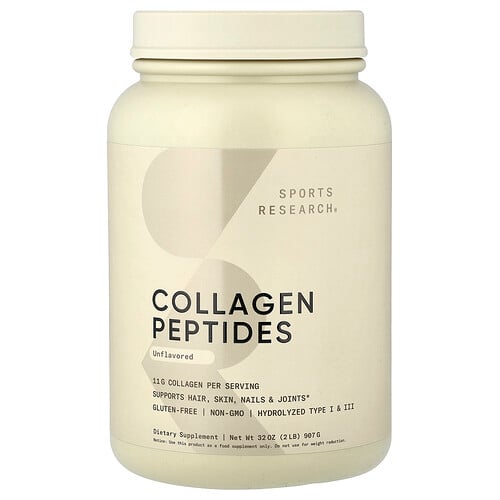
Sports Research, Collagen Peptides, Unflavored, 2 lbs (907 g)
Vitamin C Boost
Choose products with added vitamin C. Vitamin C is essential for collagen production, so having it in your supplement can help maximize your results.
Reputable Brands
Opt for reputable brands with third-party testing. This ensures the product is high quality, safe, and contains what it claims.
Marine Collagen Option
Consider marine collagen if you prefer a pescatarian option. It’s derived from fish and is rich in types I and II, which are great for skin, hair, and joint support.
If you want to try marine collagen, it’s smart to pick one that’s sustainably sourced—for your health and the planet.
A great option is Sports Research Marine Collagen (Unflavored), from iHerb. It’s made from wild-caught, sustainably sourced fish and mixes easily into any drink.
This collagen powder contains 18 amino acids, including glycine and proline, which are key players in collagen production.
Plus, you can trust the quality: it’s non-GMO, gluten-free, third-party tested, and cGMP compliant.
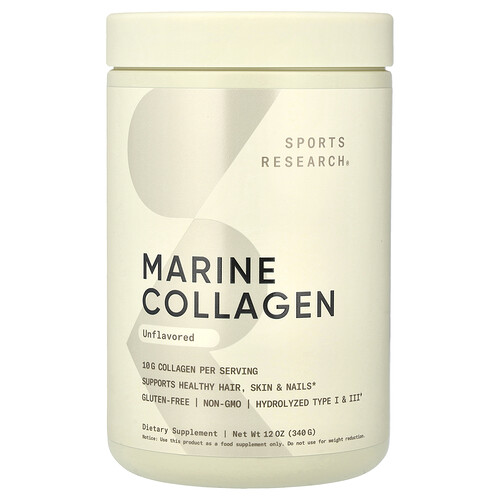
Sports Research, Marine Collagen, Unflavored, 12 oz (340 g)
Possible Side Effects and Considerations
Collagen supplements are generally safe for most people, but as with anything, there are a few things to keep in mind:
- Allergies: If you’re allergic to the source of the collagen (like fish for marine collagen), make sure to check the label carefully before using it to avoid any reactions.
- Digestive Issues: Some people may experience mild digestive discomfort, like bloating or gas, especially when they first start taking collagen. If this happens, try starting with a smaller dose and gradually increasing it.
Final Thoughts
Collagen is key to keeping your skin youthful, your hair strong, and your joints healthy.
While natural aging and other lifestyle factors can reduce collagen production, you can boost it through diet, lifestyle changes, and supplements to help support your body’s needs.
Whether you’re aiming to reduce wrinkles, strengthen your hair, or ease joint discomfort, collagen offers some exciting, science-backed benefits.
Just remember: choosing high-quality products, sticking to a healthy lifestyle, and chatting with a healthcare professional before starting any supplement will help you get the most out of it.
*This article is for informational purposes only and should not be considered medical or dermatological advice. Always consult with a dermatologist or qualified skincare professional for personalized recommendations tailored to your skin type and concerns.
Donejko, Magdalena et al. “Hyaluronic acid abrogates ethanol-dependent inhibition of collagen biosynthesis in cultured human fibroblasts.” Drug design, development and therapy vol. 9 6225-33. 24 Nov. 2015, doi:10.2147/DDDT.S91968. Abstract only.
"Facts About the Current Good Manufacturing Practice (CGMP)." U.S. Food and Drug Administration, https://www.fda.gov/drugs/pharmaceutical-quality-resources/facts-about-current-good-manufacturing-practice-cgmp. Accessed 4 December, 2025.
He, Xin, et al. "Research Progress on Skin Aging and Active Ingredients." Molecules, vol. 28, no. 14, 2023, p. 5556, https://doi.org/10.3390/molecules28145556. Adapted and used under the terms of the Creative Commons Attribution 4.0 International License.
Hexsel, Doris et al. “Oral supplementation with specific bioactive collagen peptides improves nail growth and reduces symptoms of brittle nails.” Journal of cosmetic dermatology vol. 16,4 (2017): 520-526. doi:10.1111/jocd.12393. Abstract only.
Hwang, Su Bin et al. “Hair-Growth-Promoting Effects of the Fish Collagen Peptide in Human Dermal Papilla Cells and C57BL/6 Mice Modulating Wnt/β-Catenin and BMP Signaling Pathways.” International journal of molecular sciences vol. 23,19 11904. 7 Oct. 2022, doi:10.3390/ijms231911904. Adapted and used under the terms of the Creative Commons Attribution 4.0 International License.
Kim, Ahreum, et al. "The Impact of AP Collagen Peptides (APCPs) on Hair Shaft Elasticity and Gloss: A Comprehensive Analysis." Journal of Functional Foods, vol. 122, 2024, p. 106534, https://doi.org/10.1016/j.jff.2024.106534. Abstract only.
Knuutinen, A et al. “Smoking affects collagen synthesis and extracellular matrix turnover in human skin.” The British journal of dermatology vol. 146,4 (2002): 588-94. doi:10.1046/j.1365-2133.2002.04694.x. Abstract only.
Liu, Dasong et al. “Collagen and gelatin.” Annual review of food science and technology vol. 6 (2015): 527-57. doi:10.1146/annurev-food-031414-111800. Abstract only.
Martínez-Puig, Daniel et al. “Collagen Supplementation for Joint Health: The Link between Composition and Scientific Knowledge.” Nutrients vol. 15,6 1332. 8 Mar. 2023, doi:10.3390/nu15061332. Adapted and used under the terms of the Creative Commons Attribution 4.0 International License.
Oertzen-Hagemann, Vanessa et al. “Effects of 12 Weeks of Hypertrophy Resistance Exercise Training Combined with Collagen Peptide Supplementation on the Skeletal Muscle Proteome in Recreationally Active Men.” Nutrients vol. 11,5 1072. 14 May. 2019, doi:10.3390/nu11051072. Adapted and used under the terms of the Creative Commons Attribution 4.0 International License.
Pu, Szu-Yu et al. “Effects of Oral Collagen for Skin Anti-Aging: A Systematic Review and Meta-Analysis.” Nutrients vol. 15,9 2080. 26 Apr. 2023, doi:10.3390/nu15092080. Adapted and used under the terms of the Creative Commons Attribution 4.0 International License.
Reilly, David M., and Jennifer Lozano. "Skin Collagen through the Lifestages: Importance for Skin Health and Beauty." Plastic and Aesthetic Research, vol. 8, no. 2, 2021, http://dx.doi.org/10.20517/2347-9264.2020.153. Adapted and used under the terms of the Creative Commons Attribution 4.0 International License.
Sun, Chongxiao et al. “Efficacy of collagen peptide supplementation on bone and muscle health: a meta-analysis.” Frontiers in nutrition vol. 12 1646090. 18 Sep. 2025, doi:10.3389/fnut.2025.1646090. Adapted and used under the terms of the Creative Commons Attribution 4.0 International License.
Trüeb, R M. “The impact of oxidative stress on hair.” International journal of cosmetic science vol. 37 Suppl 2 (2015): 25-30. doi:10.1111/ics.12286. Abstract only.
Wang, Hsiuying. “A Review of the Effects of Collagen Treatment in Clinical Studies.” Polymers vol. 13,22 3868. 9 Nov. 2021, doi:10.3390/polym13223868. Adapted and used under the terms of the Creative Commons Attribution 4.0 International License.
Žmitek, Katja et al. “The Effects of Dietary Supplementation with Collagen and Vitamin C and Their Combination with Hyaluronic Acid on Skin Density, Texture and Other Parameters: A Randomised, Double-Blind, Placebo-Controlled Trial.” Nutrients vol. 16,12 1908. 17 Jun. 2024, doi:10.3390/nu16121908. Adapted and used under the terms of the Creative Commons Attribution 4.0 International License.

Linda, co-founder of Courier Beauty, holds a BA in Fashion Marketing, a PG certificate in Fashion & Luxury Goods Management, and a Diploma in Natural Health Nutrition & Diet. Inspired by photography, food, and travel, she loves holistic beauty and nourishing the skin naturally.